Terns (Sternidae)

Family (Latin)
Sternidae

Terns are seabirds in the family Sternidae that have a worldwide distribution and are normally found near the sea, rivers, or wetlands. Previously considered a subfamily of the gulls, Laridae, they are now usually given full family status and divided into eleven genera. They are slender, lightly built birds with long, forked tails, narrow wings, long bills, and relatively short legs. Most species are pale grey above and white below, with a contrasting black cap to the head, but the marsh terns, the Inca tern, and some noddies have dark plumage for at least part of the year. The sexes are identical in appearance, but young birds are readily distinguishable from adults. Terns have a non-breeding plumage, which usually involves a white forehead and much-reduced black cap.

Gelochelidon nilotica

The gull-billed tern (Gelochelidon nilotica), formerly Sterna nilotica, is a tern in the family Laridae. It is widely distributed and breeds in scattered localities in Europe, Asia, northwest Africa, and the Americas. The Australian gull-billed tern was previously considered a subspecies.

Thalasseus sandvicensis

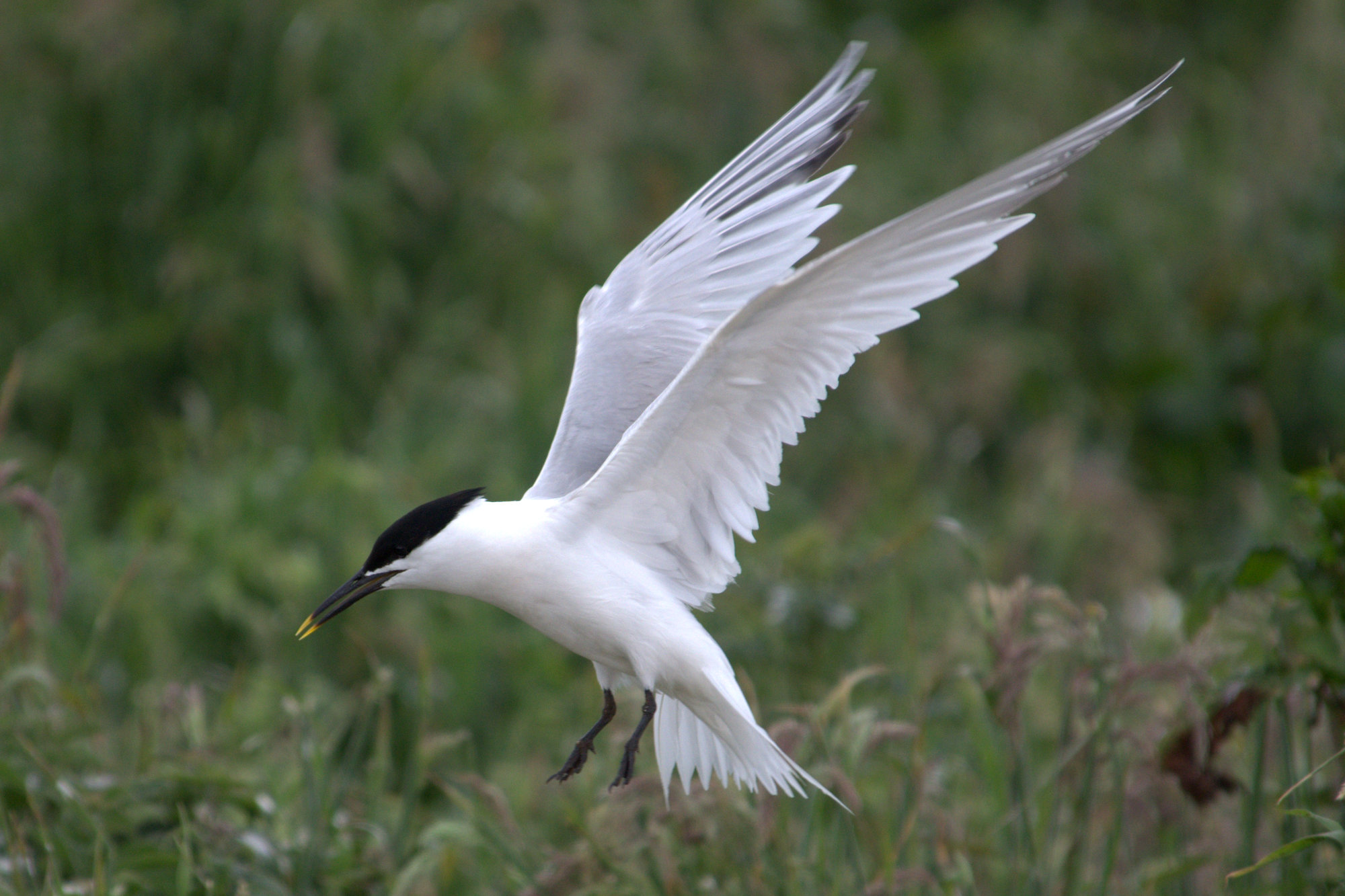
The Sandwich tern is a medium-large tern with grey upperparts, white underparts, a yellow-tipped black bill and a shaggy black crest which becomes less extensive in winter with a white crown. Young birds bear grey and brown scalloped plumage on their backs and wings. It is a vocal bird. It nests in a ground scrape and lays one to three eggs.

Like all Thalasseus terns, the Sandwich tern feeds by plunge diving for fish, usually in marine environments, and the offering of fish by the male to the female is part of the courtship display.

Sterna hirundo

The common tern is 31–35 cm (12–14 in) long, including a 6–9 cm (2.4–3.5 in) fork in the tail, with a 77–98 cm (30–39 in) wingspan. It weighs 110–141 g (3.9–5.0 oz). Breeding adults have pale grey upperparts, very pale grey underparts, a black cap, orange-red legs, and a narrow pointed bill that can be mostly red with a black tip, or all black, depending on the subspecies.

Sterna paradisaea

Arctic terns are medium-sized birds. They have a length of 28–39 cm and a wingspan of 65–75 cm .They are mainly grey and white plumaged, with a red/orangish beak and feet, white forehead, a black nape and crown (streaked white), and white cheeks. The grey mantle is 305 mm, and the scapulae are fringed brown, some tipped white. The upper wing is grey with a white leading edge, and the collar is completely white, as is the rump. The deeply forked tail is whitish, with grey outer webs.